
Kanban Mode NEW
InfoValue affiliation: agentic loop engineering · multi-session orchestration
Kanban Mode replaces the old model — driving one SPEC at a time in a single session — with a multi-session board. One lead session conducts, companion sessions work simultaneously each in their own worktree, and completed cards flow across the board. The backbone of that board is the Origin-Trail Chain.
You start it by attaching the --kanban (short -k) switch to the session launcher. It is neither a new subcommand nor a new runtime — it is merely an entry contract under which the launcher arms the kanban-mode environment. The three phases of the chain (plan → run → sync — the review verdict is absorbed by the sync gate) and the human gates inherit the existing /moai goal engine and full-pipeline chaining rules as-is. The bulk shape — many cards carried at once by numbered lanes — is split off as Factory Mode (-f), covered in the “Factory Mode” section below.
This page covers the entry conditions of Kanban Mode, the Origin-Trail Chain design, the chain phases, and “what is not automated.” For a short introduction from the workflow-command viewpoint, see /moai unified command first.
InfoAnalogy: each card on a kanban board is one worktree session. As cards flow across the board, sessions flow along the chain.
In the old model, a single session owned one SPEC end to end — writing the plan, implementing in run, and tidying docs in sync. As a SPEC grows large, one session struggles to handle it, and when it hits the context-window limit, the session must be split.
Kanban Mode reframes this structure from a board viewpoint:
- One lead session writes the plan and coordinates progress.
- Several run sessions implement in parallel, each in its own worktree.
- Each session is a card on the board, and cards flow through phases.
For this multi-session board to work, “where did this session come from,” “is the parent session alive,” and “how far has it gotten” must not be lost. The Origin-Trail Chain takes on this role.
The Origin-Trail Chain is an append-only tree that tracks the lineage of multi-session worktrees. Each worktree session is a node, and parent-child edges record “this session branched off that session.”
The chain is stored in .moai/state/chain/events.jsonl. Every write appends one line via O_APPEND — there is no overwriting and no truncation. Because the kernel serializes concurrent appends, even when several sessions write simultaneously, one line never corrupts another.
flowchart TD
    Root["Root node
(primary checkout)"]
    Spawn1["Session A
(worktree 1 · depth 1)"]
    Spawn2["Session B
(worktree 2 · depth 1)"]
    Spawn3["Session C
(worktree 3 · depth 2)"]
    Root -->|"node-enter"| Spawn1
    Root -->|"node-enter"| Spawn2
    Spawn1 -->|"node-enter"| Spawn3
    Spawn1 -->|"completion-edge"| Done1["Milestone complete"]
    Spawn2 -->|"completion-edge"| Done2["Milestone complete"]
Three event types are recorded in the stream:
| Event | When recorded | Contents |
|---|---|---|
node-enter | at worktree spawn time | node ID, parent node, depth, lineage chain, worktree path, SPEC ID, entry time |
node-update | on child SessionStart or milestone completion | session ID backfill or milestone state update |
completion-edge | on session end (SubagentStop hook) | parent-child nodes, completed milestones, next resume target |
The event stream is a flat file, but at read time BuildNodes() replays the events to derive the current node state. No mutable tree file exists.
Each node is reconstructed at read time as a state view with 13 fields:
| Field | Meaning |
|---|---|
node_id | monotonically sortable unique ID (millisecond timestamp + random) |
parent_node_id | the parent node that spawned it. Empty for the root |
depth | nesting depth. Primary checkout is 0, first worktree is 1 |
origin_chain | the ID path from root to this node (O(1) lineage lookup without traversal) |
worktree_path | absolute worktree path |
session_id | the Claude Code session ID assigned by the runtime (filled via two-phase backfill) |
spec_id | the SPEC identifier this node works on |
milestone | current milestone label |
entered_at | node creation time (RFC 3339) |
exited_at | session end time. Derived from heartbeat staleness (not an exit event) |
last_completed_milestone | the most recently marked-complete milestone |
resume_target | one-line description of what to do on resume |
resume_command | the single command to run on resume |
Sessions that reuse the same worktree path can collide — if you delete a worktree and recreate it at the same path, two sessions share the same worktree_path. The chain distinguishes them by the (worktree_path, session_id) pair:
- Primary key: find the node whose
(worktree_path, session_id)pair matches exactly. - Fallback: if
session_idis empty or no matching node exists, resolve to the most recently entered node at that path.
This mechanism accurately restores “what is the current node for this path” when resuming a session after /clear.
The Origin-Trail Chain solves two problems:
Depth amnesia — when re-entering after /clear from a deeply nested worktree, “who are this session’s ancestors” is lost. You had to recover it through grep or scrollback archaeology. The chain denormalizes the full ID path from root to leaf in the origin_chain field, restoring lineage in O(1) without traversal.
Dead leader socket — the state where the lead session has died but the child session does not know it. The child sits frozen waiting for the dead leader. The chain records session termination with completion-edge events, so together with heartbeat staleness (the derived exited_at), a child can detect its parent’s state.
An infinitely deep session tree makes complexity uncontrollable. The chain caps complexity with a depth ceiling — beyond the ceiling it refuses deeper spawns and guides work to shallower layers.
At the moment of spawning a worktree, the session ID is not yet known — because the Claude Code runtime assigns the session ID only after starting the child process. So it is split into two phases:
- At spawn time: append a
node-enterevent withsession_idleft empty. The node ID is passed to the child process via theMOAI_CHAIN_NODE_IDenvironment variable. - At child SessionStart: once the runtime assigns the session ID, backfill
session_idwith anode-updateevent.
This protocol bridges the gap between spawn time and session-ID assignment time.
In v3.1 the entry path of Kanban Mode is wired end to end. Each surface differs in completeness, though, so it is worth separating what you can use from the command line today from what still lives only in the library layer.
-k/--kanbanlauncher switch — wired into bothmoai ccandmoai glm. Passed bare (or with a SPEC identifier) it enters as the lead; passed as-k --name <role>it joins an already-open run as a companion session. The mixed-backend launchermoai cgrefuses it with a sentinel.-f/--factorylauncher switch — the dedicated Factory Mode entry.moai cc -f Nannounces the lead together with the launch commands for laneslane-1…lane-N, andmoai cc -f lane-<n>adds one lane at a time. Covered in the “Factory Mode” section below.- Bootstrap notice — when the lead session opens, the SessionStart hook prints the run identifier and the three companion launch commands (
moai cc -k --name planand so on) in the user’s language. The notice reaching a companion announces which run it joined and the session name. Names are bare role names (plan,run,sync); if a live session already claims the same role name, the next number is attached (plan-1,plan-2, …). The notice also carries the recommended backend mix and the per-session concurrent-agent cap (10). - Session record — the entered session’s role, backend, and target SPEC are recorded.
moai chainCLI — five subcommands work:status(current-node summary),lineage(root-to-leaf lineage),back(parent node’s resume target and command),list(all nodes with freshness),prune(folding terminated old nodes into an archive). Theinternal/chain/storage layer below backs them.- Dispatch — the actor moving cards between columns is the lead session’s orchestrator. The protocol lives in
.claude/rules/moai/workflow/kanban-dispatch.md, and companion sessions are launched by hand, one per terminal. There is no path by which a session launches another session.
internal/chain/store.go— append-only JSONL writer/reader. Appends one line at a time viaO_APPEND, and skips corrupt lines with skip + warn.internal/chain/node.go—WorktreeNode(13 fields) +ChainEventtype definitions.internal/chain/populate.go—Populator: node creation at spawn time, session ID backfill, milestone update, completion-edge recording, current-node interpretation.GenerateNodeID— generates IDs with a monotonic timestamp + random, with no external dependencies.
The board state store in internal/kanban/ is complete as code — a closed five-column enumeration (backlog → plan → run → sync → done), a single-origin state file converging on one primary checkout, file locking, corruption recovery, and reconciliation with SPEC frontmatter status (it marks mismatches rather than fixing them). But no production caller reads or writes it yet. That means column position is held by the lead session’s memory and the SPEC status, not by a file, and no CLI verbs exist to view the board or move a card.
WarningThere is nomoai kanbancommand. The CLI surface of Kanban Mode is the launcher switch-kand the lineage query commandmoai chain, nothing else.
InfoNot a slash command: Kanban Mode is not a/command in the Claude Code chat window; it is a switch that opens the session itself. You attach it in the terminal when starting the session.
Start in the terminal by attaching --kanban (short -k) to the MoAI launcher (moai cc or moai glm). If you also pass a SPEC identifier, that SPEC is the target; if you omit it, plan-phase begins from the first prompt.
# Enter as the lead — start the kanban chain targeting a SPEC
$ moai cc --kanban SPEC-AUTH-001

# Short form
$ moai cc -k SPEC-AUTH-001

# Without a target SPEC — start plan from the first prompt
$ moai cc -k

# Same entry on the GLM backend
$ moai glm -k SPEC-AUTH-001
When the lead session opens, it prints the run identifier together with the three companion launch commands. A human runs each one in a separate terminal to populate the board.
# Companion sessions — join under their bare role name (the run-id is the lead's identifier)
$ moai cc -k --name plan
$ moai cc -k --name run
$ moai cc -k --name sync
On successful entry the launcher arms the kanban-mode environment (the MOAI_KANBAN chain seed) inside the session, and the lead’s SessionStart notice announces the run id and the companion launch commands — not a new runtime or hook, but an entry contract riding on existing machinery.
Opening the lead with moai cc -k prints one launch command per companion session alongside the run identifier. The operator opens each of them in its own terminal to complete the four-session run — the lead instructs, and plan · run · sync each work in their own worktree.
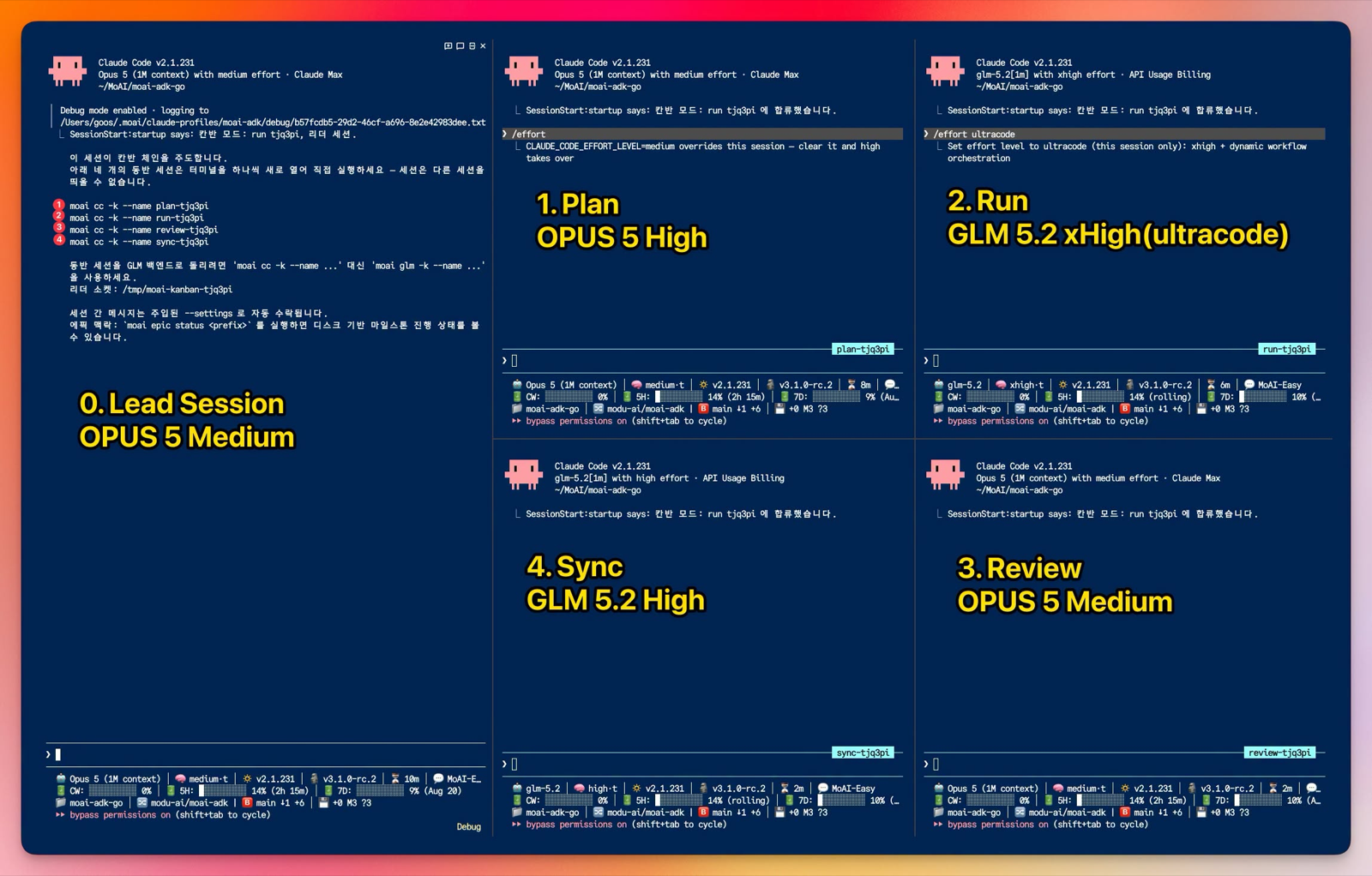
Cards flow like this: the lead instructs the plan session to author, the run session implements from that plan, and the sync session reconciles the code with the SPEC and commits. The review verdict is not a separate column: the sync gate absorbs it, running the review lenses itself. Each dispatch happens only after the lead has read the phase’s progress evidence.
Each of the three companions can call sub-agents in parallel. The plan session in particular fans out SPEC authoring across cards — one parallel Agent() worker per card directory, so authoring does not wait its turn one card at a time. The concurrent-agent count is capped at 10 per session: the launcher injects a CLAUDE_CODE_MAX_CONCURRENT_SUBAGENTS cap into each companion, so even with all four sessions fanning out at once, the machine’s capacity is divided by construction rather than by operator restraint.
InfoWhy this shape — a backend per role. Design and leading run on Opus; implementation runs on GLM. When opening companions,moai glm -k --name ...instead ofmoai cc -k --name ...joins that session on the GLM backend. Keeping the expensive model where judgment is needed and routing the implementation load to the cheaper backend is what makes the token cost of a multi-session run sustainable. Sessions message each other, and cross-session messaging is auto-permitted through the injected--settings.
The bootstrap notice carries a default recommendation. Token availability first:
moai glm -k                    # lead — the seat that watches the queue and moves cards
moai cc  -k --name plan        # plan — design and judgment on Claude
moai glm -k --name run         # run — implementation-heavy work on GLM
moai cc  -k --name sync        # sync — review and wrap-up on Claude
The reasoning is the kind of thinking each role needs. Plan and sync turn on judgment and review, so they sit on Claude; run is implementation-heavy, so GLM keeps its cost down. The lead is not the seat that renders verdicts — it watches the queue and moves cards — so GLM, cheap to keep waiting, fits it. When a Claude verdict is needed under a GLM lead, escape through a session named judge — the only route by which the GLM lead uses Claude. When one account starts hitting 429s, spreading sessions across accounts is the workable move. This mix is only the default — a different combination, or unifying every session on one backend, is equally fine.
The model labels visible in the screenshot’s statuslines reflect one operator’s session at capture time, not the shipped default.
InfoValue affiliation: multi-session orchestration · tokenomics
If kanban is the shape where “three roles carry one card through the phases,” Factory Mode is the shape where “N numbered lanes carry several cards at once.” A card does not hop between columns — it goes whole into one free lane, and that lane carries it through plan → run → sync in order, in-session — each phase is spawned and run as an Agent() sub-agent. The entry is the dedicated token -f: open a lead and four lanes with moai cc -f 4, and grow one lane at a time with moai cc -f lane-<n> (or moai glm -f lane-<n>).
The per-lane concurrent-agent cap (10), the reason for staggered activation, lane-number ownership (workers.json), worktree isolation for write spawns, and where factory diverges from kanban are covered on the dedicated Factory Mode page.
Rather than scanning four terminals by eye, moai web shows the same state on one screen. The Kanban screen carries the kanban chain board alongside the SPEC pipeline, with Overview, Specs, Monitor, and Settings screens beside it.
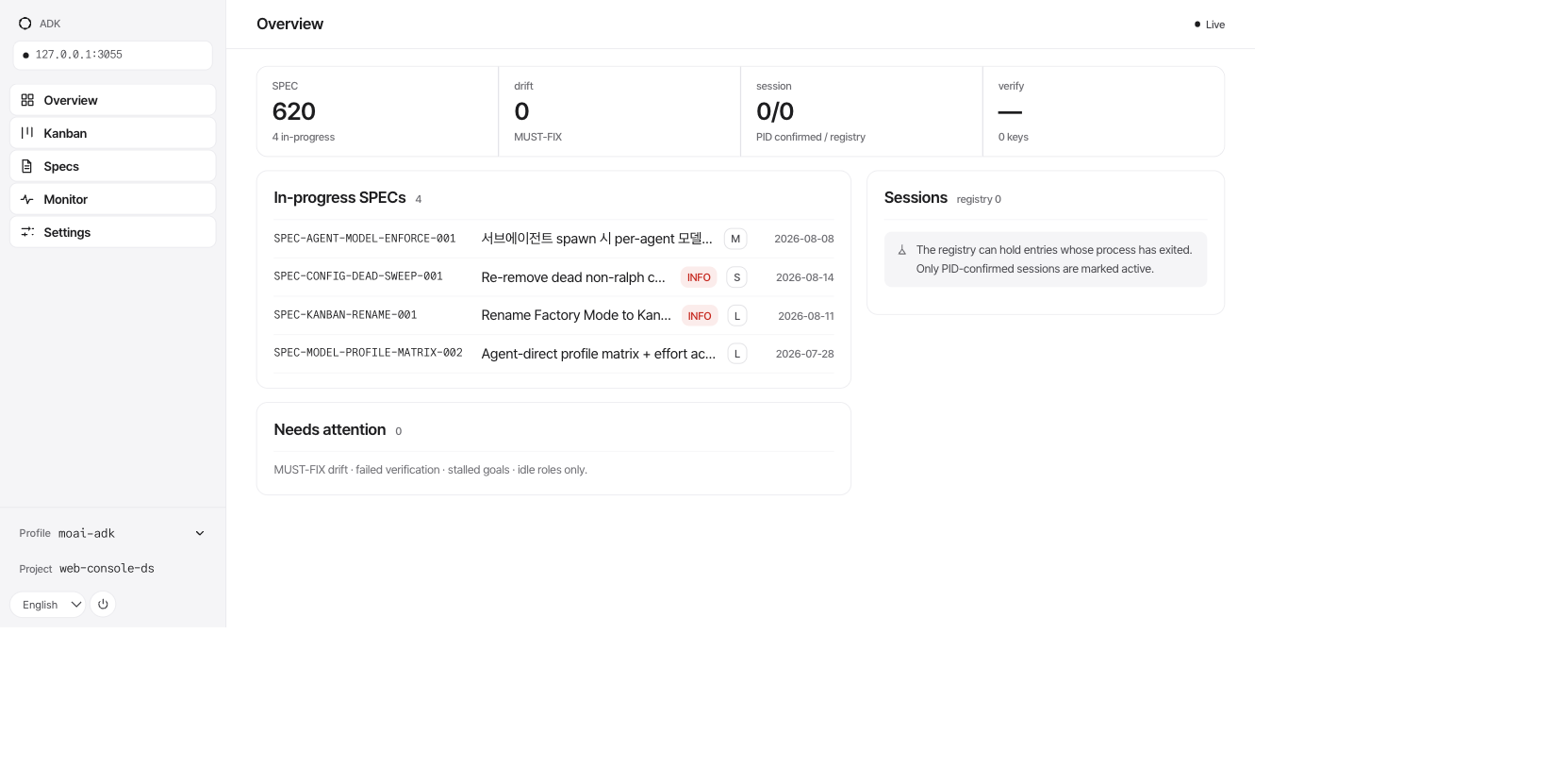
The console binds to loopback only. See moai web console for the full guide.
The kanban chain extends the full-pipeline contract (an agreement that auto-chains run → sync for one SPEC). Three phases proceed in order:
flowchart TD
    Entry["--kanban entry
(target SPEC or first prompt)"] --> Plan["plan
SPEC authoring + independent audit"]
    Plan --> Gate1{"Implementation Kickoff Approval
(human gate)"}
    Gate1 -->|"approved"| Run["run
implementation cycle → AC convergence"]
    Gate1 -->|"declined"| Stop1["Stop"]
    Run --> Sync["sync
review lenses + docs · changelog · closure"]
    Sync --> Done["Chain complete"]
The detailed procedure of each phase inherits the existing chaining rules:
- plan — authors the SPEC document, and an independent audit (plan-auditor) verifies its contents. See
/moai plan. - run — the implementation cycle (TDD or DDD) implements code until it converges on the Acceptance Criteria (AC). See
/moai run. - sync — the sync gate runs the review lenses (matched to the surfaces the change touched) and reaches the review verdict itself, then updates docs, writes the changelog, and closes the phase. See
/moai sync.
What Kanban Mode adds on top is the multi-session board viewpoint — the lead session coordinates, run sessions work in parallel, and the Origin-Trail Chain tracks that lineage. For the detailed rules of the chain phases themselves, see the /moai unified command and /moai goal.
Most of what piles up in the backlog is small chores — a one-line fix, a stale reference, a flag rename. Pushing these through the full plan → run → sync costs more ceremony than the change is worth. So each time a card leaves backlog, the lead classifies it into one of three classes and names the class in the dispatch.
| Class | Shape | Shortcut |
|---|---|---|
| A — direct close | a one-file, one-line change with no design judgment in it, where CI catches the regression | one session carries it all the way to the PR. plan skipped |
| B — defect, cause unknown | something is broken but the cause is not yet established | run → sync. Skips plan, so no SPEC exists |
| C — design change | carries a decision or spans subsystems | all three working columns |
Class A is admitted only on checked evidence. Two of its three properties are mechanically checkable, and are checked and cited — a diff measured to one file (git diff --stat), and green CI on the head that will merge. The third — that there is no design judgment in it — is a judgment, stated in the dispatch where the operator can disagree with it. A card that cannot cite either measurement is not Class A. The justification is never “it is faster”: speed is the effect of skipping the columns, not the reason, and a card that claims Class A on speed alone is a Class C card being rushed.
Class B skips plan, not the review. An unestablished cause is precisely what a review catches, so the sync gate’s review runs unchanged. Instead, the cause-establishing evidence — the reproducing command and what it printed — is written into the card’s progress record, and the run session names that path in its completion report. The lead reads the path and confirms the cause — it does not pass the card on trust.
From the parallelism viewpoint, the classes decide where the parallelism comes from. Handing one whole card to each of the three sessions lets three cards flow at once; pipelining one card through the three columns lets only one flow. The pipeline repays its handoff cost only when each column does a proper share of the work — which is the Class C case, and the reason the investigation fan-out during plan is reserved for Class C.
The unattended foreman — a bare /loop NEW · v3.1.1
NEW · v3.1.1" aria-label="Anchor to: The unattended foreman — a bare /loop NEW · v3.1.1" href="#the-unattended-foreman--a-bare-loop-hahahugoshortcode405s7hbhb">
In this project, typing /loop with no arguments makes that session repeat one kanban foreman cycle unattended. It is not the ordinary iterative-fix loop: it is a watch-dispatch-collect cycle over the backlog queue.
What one iteration does is small and idempotent.
flowchart TD
    Start["bare /loop — one iteration begins"] --> Skill["Load the moai-kanban-foreman skill"]
    Skill --> Fail{"Skill missing or
failed to load?"}
    Fail -->|Yes| Stop["Stop the loop + one-line reason
(never improvise a replacement protocol)"]
    Fail -->|No| Watch["Arm the queue watch if it is not armed yet"]
    Watch --> Check["Check the backlog queue"]
    Check --> One["Dispatch or collect evidence for ONE card
(at most one per iteration)"]
    One --> Report["Close with a 2-6 line report, then reschedule"]
Three boundaries bind this loop.
- It cannot ask the operator. While the skill is active,
AskUserQuestionis removed from the tool pool. The loop runs with nobody watching, so there is no channel to ask through — anything needing judgement is reported in the iteration output instead. - It schedules work, it never generates it. Admitting a card to the backlog (
moai todo add) and picking the next one remain the operator’s acts. The foreman only moves an already-picked card into a free lane. - It answers no approval gate on the operator’s behalf. Implementation Kickoff Approval and every other human gate still fire inside the unattended loop, and the foreman never passes one by proxy.
Completion is always judged on evidence it read — the card advances on the progress record on disk, not on a lane’s reply. To test a single cycle by hand, invoke the moai-kanban-foreman skill directly.
InfoOne lead, three companions. Entry and dispatch work in v3.1. The board state store that would pin column positions to a file has no callers yet, so the current position of a card is held by the lead session and the SPEC status.
When to use — when advancing one SPEC (or several SPECs) simultaneously across multiple worktree sessions. When you need to track session lineage with the Origin-Trail Chain. When you want to drive one SPEC all the way to closure in one go. When many cards of the same shape have piled up and you want them split across parallel lanes, Factory Mode (-f) is that shape.
When not to use — when you want a human to judge and review intermediate artifacts between phases (in this case, run the ordinary plan → run → sync turn by turn). Short work that finishes in a turn or two. When you need the mixed backend (moai cg).
This page states explicitly what it does not do:
- It is not a new subcommand —
--kanbanis a launcher switch, not a chat command like/moai kanban. - It does not skip human gates — Implementation Kickoff Approval, the pre-implementation quality gate, and the documentation-scope gate all still fire. Even if the chain flows automatically, each gate requires human approval.
- Unsupported backend — Kanban Mode is rejected by the mixed-backend launcher
moai cg.moai cgruns the leader on one backend and teammates on another, which contradicts the chain’s precondition of “one session / one backend / one chain.” The session does not open, accompanied by a rejection sentinel.
/moaiunified command — a short introduction from the workflow-command viewpoint/moai todo— the backlog queue that admits cards onto the board/moai loop— the unattended foreman driven by a bare/loop: one session that watches the backlog queue, routes operator-picked cards to free lanes, and collects evidence, on repeat/moai goal— the goal engine that drives the kanban chain- Factory Mode — the second form, carrying several cards at once, each loaded whole onto a lane
- manager-lead Lead Coordinator — the coordination agent that drives dispatch inside a kanban or factory lead session
- Autonomous continuation loop — ownership and guardrail comparison of
/moai goal,/moai loop, and the native/goal /moai run— run-phase autonomy wiring, the rules the kanban chain’s run phase inherits- Harness engineering — how phase chaining and observation sit on top of the harness design
- Statusline — how session lineage and worktree state are displayed in the statusline